August 2026 jobs report: A rebound built on restaurants and classrooms
August 2026 jobs report: A rebound built on restaurants and classrooms
The latest U.S. labor market data points to a labor market that found its footing in August after two months that looked far weaker at the time than they do now. The August Employment Situation report from the Bureau of Labor Statistics (BLS) shows a solid rebound in payrolls, an unemployment rate holding steady, and upward revisions that erased July's reported job loss entirely, trends that matter most for employers relying on hourly, frontline labor.
In August, total payrolls rose by 162,000, roughly triple what most economists had forecast, while private employers added 127,000. The unemployment rate was unchanged at 4.1 percent. Taken together, the numbers describe a genuine rebound built on a narrow base, since restaurants and local schools accounted for most of the month's gain while several frontline industries lost ground.
What the numbers tell us
The composition of the report matters more than the headline. Food services and drinking places added 59,200 jobs and local government education added 41,900, which together account for roughly 62 percent of the month's total gain. That leaves about 61,000 jobs spread across the rest of the economy, a pace much closer to the sluggish summer than the headline suggests.
Wage growth continued to ease. Average hourly earnings rose 10 cents to $37.75 and are up 3.1 percent over the year, the slowest annual pace since 2021. The average workweek edged up to 34.4 hours, and labor force participation ticked up to 61.6 percent, though it remains half a percentage point below where it started the year.
One detail deserves attention from anyone planning shifts. The number of people working part time for economic reasons fell by 414,000 to 4.4 million. That points to employers restoring hours they had trimmed over the summer rather than adding large numbers of new positions, which is a quieter kind of recovery than the headline implies.
June and July were revised up by 55,000 combined
The BLS revised June's gain from 20,000 up to 31,000, and July's from a loss of 23,000 up to a gain of 21,000, a combined 55,000 more jobs than first reported. July's revision is the consequential one, because it turns a reported contraction into modest growth and removes the single data point that had anchored much of the talk about a stalling labor market.
Revisions of this size cut both ways. A separate preliminary benchmark revision released in late August showed 79,000 fewer jobs added since January 2025 than previously estimated, including 178,000 fewer in the private sector. The freshest number remains the least reliable one, and staffing plans built on any single month's print carry more risk than they used to.
What this means for hospitality and events employers
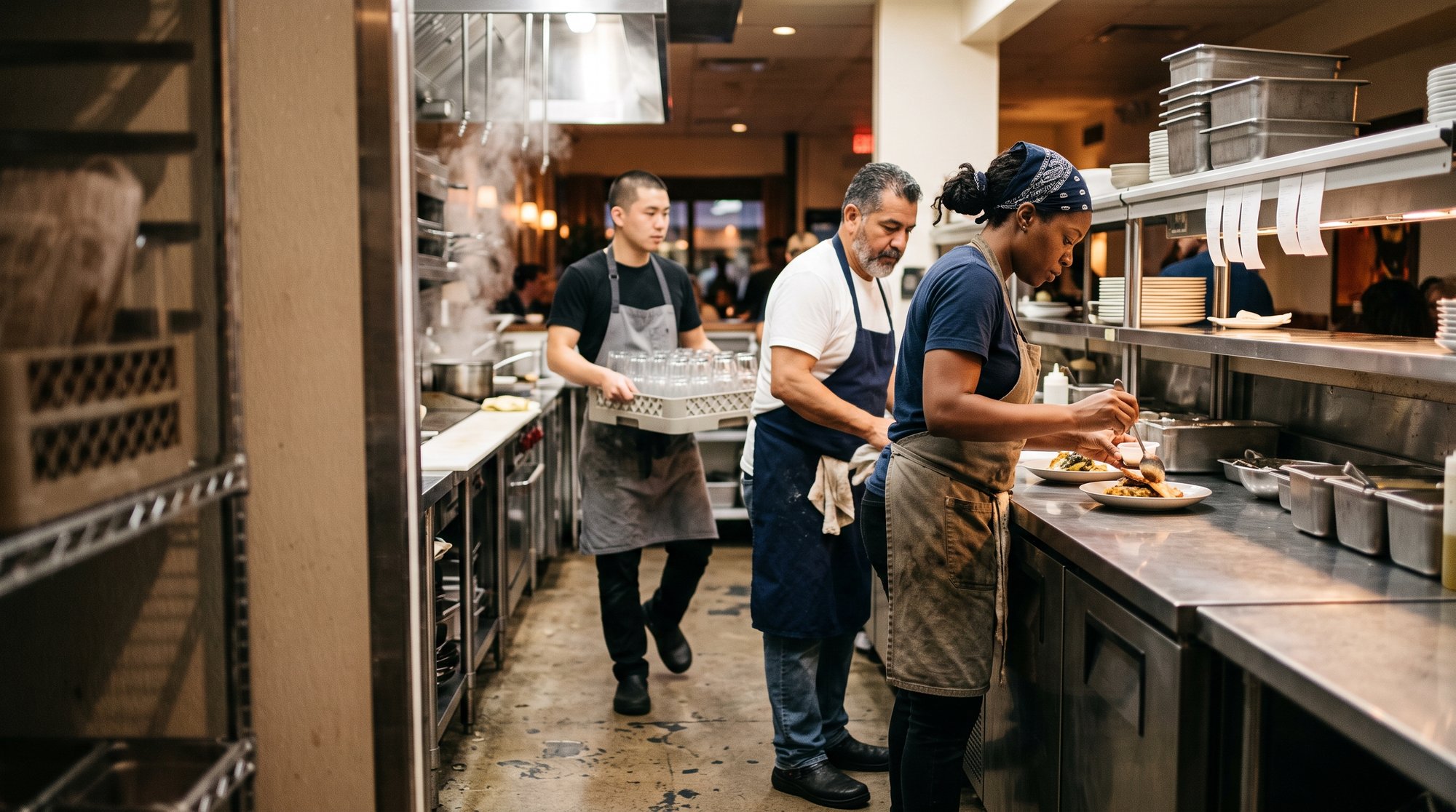
Leisure and hospitality added 62,000 jobs in August, the strongest gain of any private industry, and effectively all of it came from accommodation and food services. Food services and drinking places added 59,200, well above the average monthly gain of 12,000 over the prior year, and accommodation added 8,600.
The rest of the sector moved the other way. Arts, entertainment, and recreation lost 6,300 jobs, with performing arts and spectator sports down 2,700 and amusement, gambling, and recreation down 4,400. Some economists attribute part of August's surge to seasonal adjustment factors distorted by World Cup hiring patterns earlier in the summer, which argues for reading one strong month as encouraging rather than decisive.
For restaurants, hotels, and event operators, the practical read is that everyday dining and lodging demand is healthy while live event staffing is not. Teams that can move coverage between those two patterns, instead of staffing to one and hoping, will handle the fall with fewer gaps.
What this means for retail and merchandising operators
Retail trade added just 1,400 jobs in August, a flat headline covering a real split underneath. General merchandise retailers added 13,100 positions, including 9,100 at warehouse clubs and supercenters and 4,000 at department stores, while food and beverage retailers lost 4,400, gasoline stations and fuel dealers lost 2,400, and building material and garden supply retailers lost 2,000.
For retail and merchandising operators, the pattern suggests large-format stores are staffing up ahead of the fourth quarter while smaller formats hold back. That points toward leaner permanent rosters into peak and heavier reliance on flexible coverage for resets, inventory counts, and promotional pushes.
What this means for warehousing and logistics teams
Transportation and warehousing added 5,000 jobs in August, but the gain came from trucking rather than from fulfillment. Truck transportation added 4,800 positions and transit and ground passenger transportation added 3,700, while warehousing and storage lost 2,600, couriers and messengers lost 3,000, and air transportation lost 1,600.
That is the second consecutive month of losses in warehousing, and this time courier hiring did not offset it. For warehouse and logistics leaders, fixed fulfillment capacity is being trimmed heading directly into the holiday ramp, and that gap usually gets filled later with flexible labor at short notice. Lining up that coverage now is materially cheaper than sourcing it in November.
Why this report matters for hourly workforce planning
Across hospitality, retail, and logistics, August's data shows employers restoring hours and hiring selectively rather than committing broadly to new headcount. Wage growth of 3.1 percent over the year and a 34.4 hour workweek suggest labor costs are not accelerating, which gives operators more planning room than they had a year ago.
The narrowness is the caution. When two industries produce most of a month's job growth, an aggregate rebound says very little about any particular vertical. Operators who track demand inside their own sector, and who can staff to it on short notice, will be better positioned than those reading the headline alone.
Looking ahead
August's report describes a labor market steadier than July's initial print suggested but still growing on a narrow base, with restaurants and schools carrying the month while warehousing and couriers gave ground. The September jobs report, due out October 2nd, will show whether hospitality's momentum held and whether logistics hiring turns upward ahead of peak season.
For hospitality, retail, and warehousing teams alike, the months ahead will reward flexibility. The ability to adjust staffing quickly, respond to industry-specific demand shifts, and meet workers where they are will define who stays resilient through the holiday peak.

